For TEMG4000A @ HKUST for the summer of 2012
One of the most important ways to represent yourself in a concise and memorable way is to prepare a short speech description of who you are. This short speech is often called an, “Elevator Pitch” due to its short length, approximately less than 1 minute, in situations you are sometimes forced to speak briefly in elevators, networking events, beginning of job interviews, or when you show up late for your first class and your professor is not happy.
The Content:
An Effective Elevator Pitch answers 4 Basic Questions:
- Who are you? Simple introduction including your name and what you do
- What do you want to do? This is what you are interested in doing in the future>
- What makes you stand out in a crowd? This is the part where your skills and expertise come in handy. It is important to know your audience and tailor-make your pitch for the occasion. It is unlikely that a McKinsey HR director cares whether or not you have a Scuba Diving certificate.
- What is next?
TIPS
Your pitch should take no longer than 60 seconds from start to finish, no more than a usual elevator ride. Each pitch should have its own targeted audience. Do not use a cookie-cutter pitch in all networking events. Avoid using complex words and jargons. Be simple and clear.
The How:
Many of times, how you say something is just as important as what you say. In making an unforgettable impression with your pitch, you need to be confident, conscious and specific.
Just like any public speaking occasion, confidence will take you a long way. Being able to speak naturally to your targeted audience can help you start a conversation and open doors for you. A good way to achieve this is to practice your pitch with a friend to make sure it does not sound awkward to him/her.
Being conscious is about knowing your audience and making sure that they are having a pleasant time talking to you. Remember to be mindful and observant about what kind of attention, if any, of your audience are you receiving. A mindful and respectful pitch will be more effective than a pitch that is all about you.
The goal of your pitch is to differentiate yourself from other people therefore you should try to make your elevator pitch specific. Make your intentions clear and plan your desired outcome ahead of time. Leaving hooks for people to ask questions make people want to know more about you and more willing to keep in touch.
The Don’ts:
In an elevator pitch, to capture the audience’s attention and good intentions, do not:
- Be generic – In many networking events, there are always fresh graduates looking for job offers, referral, advices, lunch meetings and these people might have similar backgrounds with yours or perhaps more impressive ones. The key is to stand out and not offer what the same thing the person next to you does.
- Be weird – Being flexible and able to read between the lines are skills that come from work experience and often hard for undergraduates. Often times, we try too hard to impress people or talk about irrelevant things. Seek out help from professors or career centers to find out more about business and networking etiquette.
- Be boring – “People don’t buy what you do, people buy why you do it,” Simon Sinek. Communicating with energy and enthusiasm is vital in a powerful pitch.
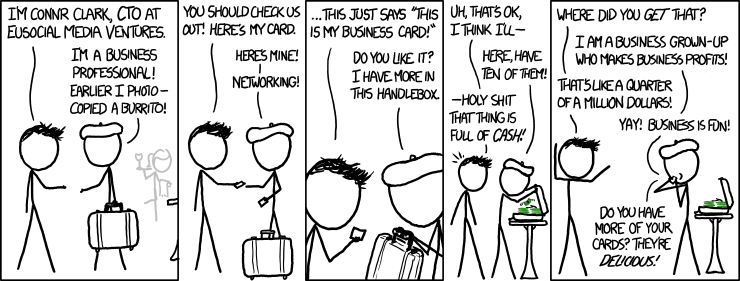
- Be afraid – Unexpected things are bound to
happen. Deal with them as they come. Here I attached a comic strip titled "Networking" from XKCD.com ->
Example:
Hi. My name is Aekasitt Guruvanich, a Computer Science student at HKUST. I am interested in career paths in the Consulting Industry, specifically IT consulting one which I can fully utilize my programming skills and expertise in Web Development. As I talked to John over there about networking last week, he recommended me expanding contacts with people in the industry as much as I can. Having worked in a global student organization like AIESEC, I am confident in my interpersonal skills with experience working across cultures and would make a good road trip passenger. In the audience today, I see many students sharing the same goal as well as Ms. Lin and John who have years of experience in the industry, therefore I look forward to setting up a meeting with each and everyone of you in order to share our resources and contacts.
